

For many undergraduate students, the transition from the classroom to the boardroom feels like a massive leap. You spend years mastering complex theories, pulling all-nighters for lab reports, and perfecting 3,000-word essays, yet when you open a blank Word document to create a resume, you feel like you have “no experience.” This is a common misconception. Your academic career isn’t just a series of grades; it is a four-year internship where you have been developing high-level transferable skills.
The secret to a successful job hunt isn’t necessarily having a long list of previous jobs; it’s about how you translate your academic labor into professional value. When recruiters look at a fresh graduate’s profile, they aren’t looking for a seasoned manager. They are looking for potential, coachability, and evidence that you can handle a workload. By learning how to craft compelling resume headlines, you can immediately signal to an employer that you understand the industry language and have successfully converted your studies into actionable expertise.
The “Academic Asset” Inventory
Before you start typing your CV, you need to conduct an audit of your university career. Most students overlook the “assets” they’ve built. Think about your major projects. Did you lead a team of four for a marketing simulation? That’s project management. Did you analyze a massive dataset for a sociology paper? That’s data literacy. Did you manage a budget for a student society? That’s financial oversight.
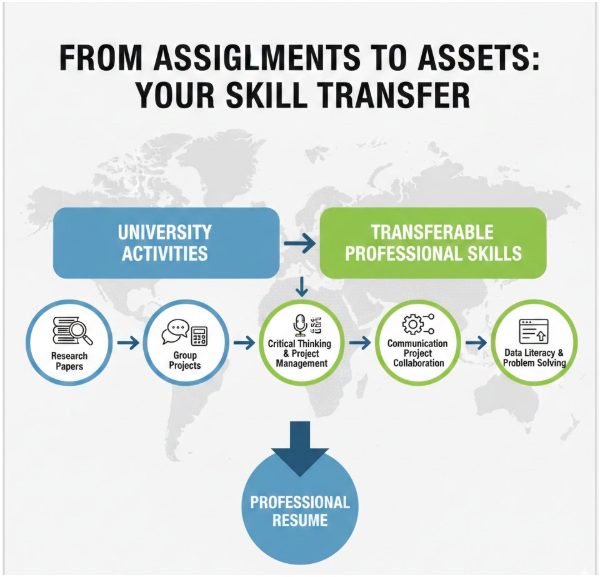
To help you visualize this conversion, look at the table below to see how common university tasks translate into the “Corporate Speak” that recruiters love to see.
| University Activity | Transferable Professional Skill | Resume Action Verb |
| Writing a Dissertation | Independent Research & Data Synthesis | Executed / Formulated |
| Group Presentations | Public Speaking & Stakeholder Management | Presented / Coordinated |
| Peer Reviewing Papers | Quality Control & Critical Analysis | Evaluated / Refined |
| Solving Complex Lab Problems | Technical Troubleshooting | Optimized / Resolved |
| Balancing 5 Modules | Time Management & Prioritization | Streamlined / Organized |
Bridging the Gap Between Theory and Practice
One of the hardest parts of being a student is the “experience paradox”—you need a job to get experience, but you need experience to get a job. This is where your coursework becomes your best friend. Instead of just listing “Modules Included: Macroeconomics,” try describing a specific project within that module.
For instance, if you’re applying for a role in communications, don’t just say you’re a good writer. Talk about the time you had to condense a 50-page research paper into a 5-page executive summary. This shows you have the “Brevity” and “Clarity” skills that businesses crave. It’s about moving from the what (I studied this) to the how (I applied this).
Crafting the Narrative: Beyond the Bullet Points
While your resume is a summary of your facts, your entry into a specific field often requires a more personal touch. This is especially true for internships or competitive graduate schemes where everyone has similar grades. At this stage, your story becomes your competitive advantage. If you find yourself struggling to articulate your journey, seeking professional guidance for personal statement writing from MyAssignmentHelp can provide the structural framework needed to ensure your narrative is both professional and persuasive.
A personal statement isn’t just a “longer version of a resume.” It is the “Why” behind the “What.” It connects the dots between your choice of degree and your future career goals. For an undergraduate, this is the perfect place to explain how a specific assignment sparked an interest in a particular industry, turning a simple grade into a career-defining moment.
Strategizing Your “Skill Sections”
Many students make the mistake of burying their skills at the bottom of the page. In a global job market, your technical skills (Python, Adobe Suite, SPSS) and soft skills (Conflict Resolution, Cross-cultural Communication) should be front and center.
Technical Skills (Hard Skills): List the software and methodologies you used during your degree. If you used Excel to run regressions, you aren’t just “familiar with Office”—you are “Proficient in Statistical Data Analysis via Excel.”
Soft Skills (Human Skills): These are harder to prove but just as vital. Instead of writing “Good communicator,” prove it by mentioning your role in a debate team or your experience as a student ambassador.
The Role of Extracurriculars and Volunteering
Never underestimate the power of your “unpaid” work. Volunteering at a local charity or running a university gaming club provides real-world experience in leadership, logistics, and consistency. These roles show that you are proactive and willing to contribute to a community—traits that are highly valued in any corporate culture.
If you managed the social media for a student club, you have “Digital Marketing Experience.” If you organized a charity run, you have “Event Logistics and Fundraising Experience.” The goal is to strip away the “student” label and look at the functional responsibilities you held.
Final Polish: The Global Standard
Since you are competing in a global market, your resume needs to be clean, ATS-friendly (Applicant Tracking Systems), and easy to read.
- Use Reverse Chronological Order: Always start with your most recent achievement.
- Quantify Everything: Instead of “Helped students,” use “Tutored 15+ undergraduate students in Mathematics, resulting in a 20% average grade increase.”
- Keep it to One Page: As a student, there is rarely a reason to have a two-page resume. Be concise.
Conclusion: Your Degree is Your Foundation
Your degree is not just a piece of paper; it is a repository of skills, projects, and experiences that are waiting to be marketed. By shifting your mindset from “I am just a student” to “I am a professional in training,” you change the way you present yourself to the world. Use your academic wins as the foundation, refine your presentation with a sharp headline, and tell your story through a compelling personal narrative.
Resources & References
To ensure the advice provided is backed by current global recruitment trends and academic standards, please refer to the following resources:
- NACE (National Association of Colleges and Employers): Job Outlook 2024 Report – Data regarding the prioritization of soft skills in entry-level hiring.
- Harvard Business Review: How to Write a Resume When You Have Little Experience – Strategies for quantifying academic achievements.
- The Bureau of Labor Statistics: Employment Projections by Education Level – Information on the correlation between specialized writing skills and career advancement.
About The Author
Hi, I’m Ruby Walker, an academic consultant and career strategist at MyAssignmentHelp. With over seven years of experience in the education sector, I specialize in helping undergraduate students bridge the gap between their university coursework and their professional aspirations.
